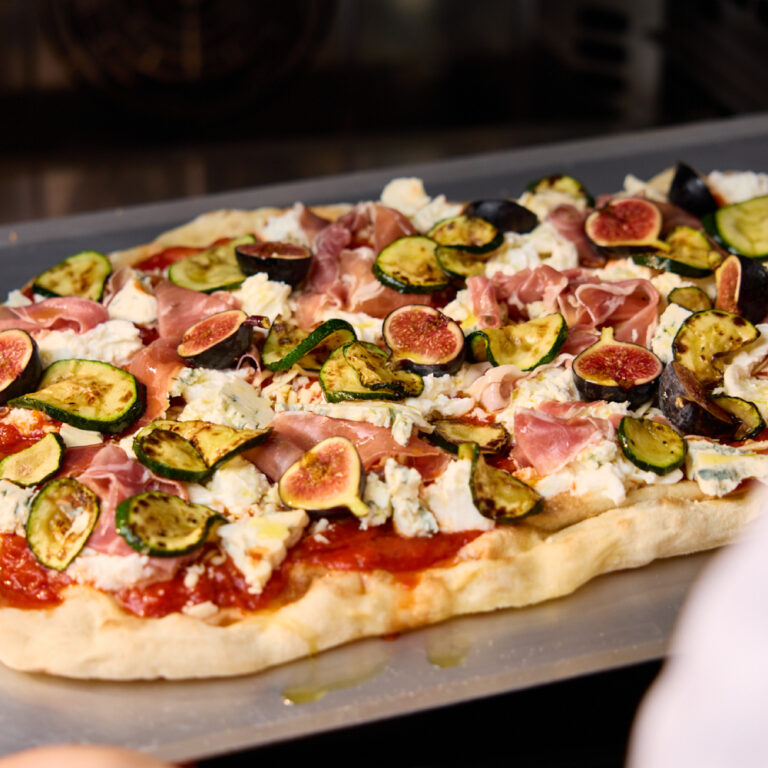
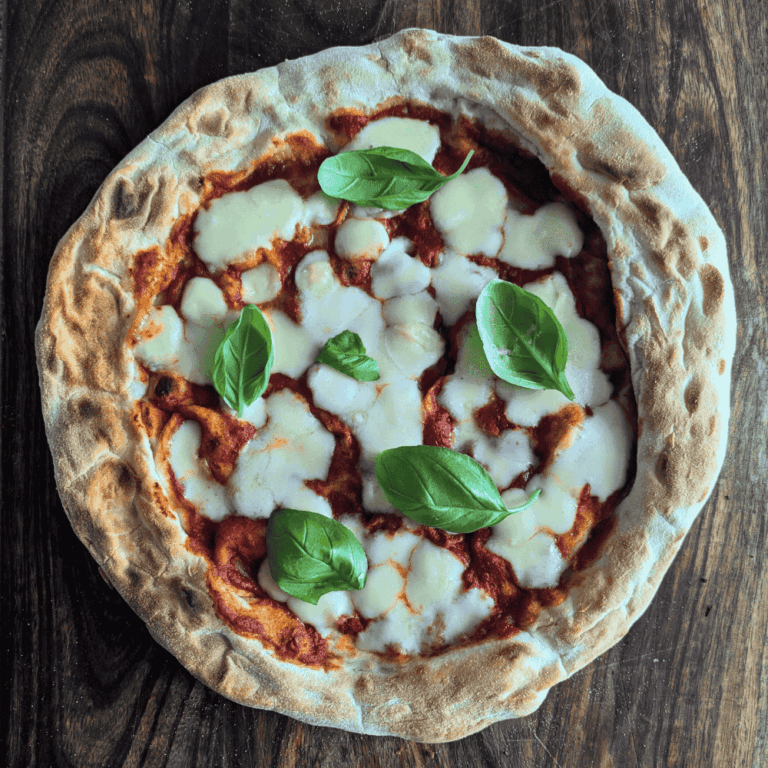
Roman-style pinsa and Neapolitan pizza differ in their dough, shape, texture and traditional cooking methods. Pinsa is commonly made with a high-hydration dough and shaped as an oval base, while Neapolitan pizza is round, with a soft centre and raised edge.
Roman pizza covers several styles. This guide focuses on Pinsa Romana as one Roman-style option, rather than using pinsa as a name for every Roman pizza. For a fuller introduction, read our guide to what Pinsa Romana is.
Roman-style pinsa vs Neapolitan pizza at a glance
| Feature | Roman-Style Pinsa | Neapolitan Pizza |
|---|---|---|
| Dough | Often made with a flour blend and a long fermentation; recipes vary. | Traditionally made from wheat flour, water, salt and yeast. |
| Hydration | Commonly described as high, though the amount varies by recipe. | Depends on the flour and method; the AVPN specification allows a range. |
| Shape | Often oval, though round formats are also made. | Round, with a raised edge called the cornicione. |
| Texture | Often crisp on the outside with a soft, airy centre. | Soft and fragrant, with a puffy edge. |
| Traditional cooking | Methods vary by recipe and product. | The AVPN specification describes very high-temperature wood-fired cooking. |
| Menu use | Pizza, flatbreads, sandwiches and sharing dishes. | Most often served as a topped pizza. |
These are broad style descriptions, not fixed rules for every recipe or commercial base.
How does the dough differ?
Pinsa dough is often associated with a flour blend, a higher water content and a longer fermentation. These choices can contribute to an open, airy centre and a crisp finish. Recipes differ, so a single ingredient list or process should not be presented as universal.
Virtue describes its Pinsa bases as made with a long-fermented sourdough recipe. The ready-to-finish, par-baked bases are made for hospitality kitchens, so teams can focus on toppings and service rather than mixing, proving and stretching dough. Explore Virtue Pinsa Romana bases.
Traditional Neapolitan dough is made from flour, water, salt and yeast. The Associazione Verace Pizza Napoletana (AVPN) publishes a defined method, including dough-ball size, fermentation and shaping. Other Neapolitan-style recipes may differ from that specification. The AVPN rules are available in English, and the UK Government also lists Pizza Napoletana as a Traditional Speciality Guaranteed food name. These references describe defined traditions; they do not mean every Neapolitan-style product is made to a protected specification.
For readers wanting to explore the styles further, the AVPN international regulations set out the association’s Neapolitan method. A UK-based professional baking source, Puratos UK’s pizza and pinsa overview, gives an accessible introduction to Pinsa’s Roman-inspired style, shape and finish. The GOV.UK Pizza Napoletana listing provides the UK protected-food-name context.
Hydration and fermentation
Hydration is the amount of water used in relation to flour. Pinsa recipes are often described as high hydration, but there is no single figure that applies to every recipe. The AVPN Neapolitan specification also allows for variation according to flour absorption, so exact percentages should be treated as recipe-specific rather than universal.
Fermentation affects how dough develops before baking. The AVPN specification gives a recommended fermentation and maturation period of 8 to 24 hours for its version of Neapolitan pizza. Pinsa processes vary, and some use longer fermentation. These differences can influence dough handling and texture, but they do not by themselves guarantee a particular nutritional or digestive effect.
Shape and texture
Pinsa is commonly presented as an oval base, with a crisp exterior and a soft, airy centre. Round Pinsa formats are also available, so shape alone does not determine whether a base is Pinsa.
Neapolitan pizza is round. In the AVPN specification, it has a soft base and a raised, puffy edge. In both styles, the finished texture depends on the recipe, preparation and cooking method.
Cooking methods
Traditional Neapolitan pizza is cooked quickly at a very high temperature. The AVPN specification describes a wood-fired oven at around 430–480°C, with a cooking time of 60–90 seconds. These figures describe the association’s defined method, rather than the instructions for every Neapolitan-style product.
Commercial pre-baked bases have their own cooking requirements. Virtue’s Pinsa instructions give different finishing guidance by oven type:
| Oven type | Virtue Pinsa finishing guide |
|---|---|
| Conventional oven | 250°C for 5–6 minutes, directly on the oven shelf or a pizza stone. |
| Stone-deck or pizza oven | 300°C for 4–5 minutes; the guide specifies 30% bottom heat and 70% top heat. |
| Wood-fired oven | Around 300°C, with the live flame reduced as much as possible; cook at a distance from the heat source. |
| Conveyor oven | 280°C on a mesh screen for 2.5–3 minutes. |
| TurboChef Fire | 320°C top / 360°C bottom on a mesh screen for 2 minutes. |
Virtue’s product guidance should take precedence over a general style comparison. For a Neapolitan-style base, a Virtue recipe gives 300°C and 4–5 minutes as a guide; actual cooking time depends on oven, toppings and service setup. See Virtue’s Neapolitan-style base.
Which style could suit your menu?
Pinsa can give a menu team several serving options from one base. Depending on the format, it can be served as a topped pizza, loaded flatbread, open or folded sandwich, garlic bread or sharing dish. Virtue’s range includes round, oval, mini and larger formats for different portions and menu occasions.
Explore the Pinsa Romana bases for formats and trade details.
Neapolitan-style pizza offers a familiar round format with a soft centre and raised edge. Virtue’s pre-stretched, par-baked Neapolitan-style base is designed to offer that puffy edge without dough stretching during service. Browse the Neapolitan base range.
The practical choice depends on your menu, oven setup, portion size and service pattern. Trade teams can test a Pinsa base with their own toppings and equipment before deciding how it fits their offer.
Try an oval format with a Pinsa sample or browse the full Pinsa range.
Frequently asked questions
Is Pinsa the same as Roman pizza?
Pinsa is one Roman-style product. Roman pizza also includes other styles, so “Roman pizza” does not always mean Pinsa.
Is Pinsa different from Neapolitan pizza?
Yes. Pinsa is commonly associated with higher-hydration dough, an often-oval shape and a crisp outside with a soft centre. Neapolitan pizza is round, with a soft base and raised edge. Recipes and finished textures vary.
Can Pinsa be used for more than pizza?
Yes. Depending on the base format and your menu, it can also be used for flatbreads, sandwiches, garlic bread and sharing dishes.
Where can I compare Virtue’s Pinsa and Neapolitan bases?
Browse Virtue’s Pinsa Romana bases and Neapolitan bases. Trade customers can order an oval Pinsa sample to test in their kitchen.
Try the formats in your kitchen
Compare the bases with your own toppings, oven and service workflow. Order a Pinsa sample or explore the full Pinsa Romana range.